Owners of aging business software
Companies whose booking, ordering or internal system still works but is slow, hard to change and understood by fewer people every year.
Replace the application your business has outgrown without stopping the business. We audit it, rebuild it in parts while the old system keeps running, move the data and switch over when the new version has proven itself.
Tell us what you need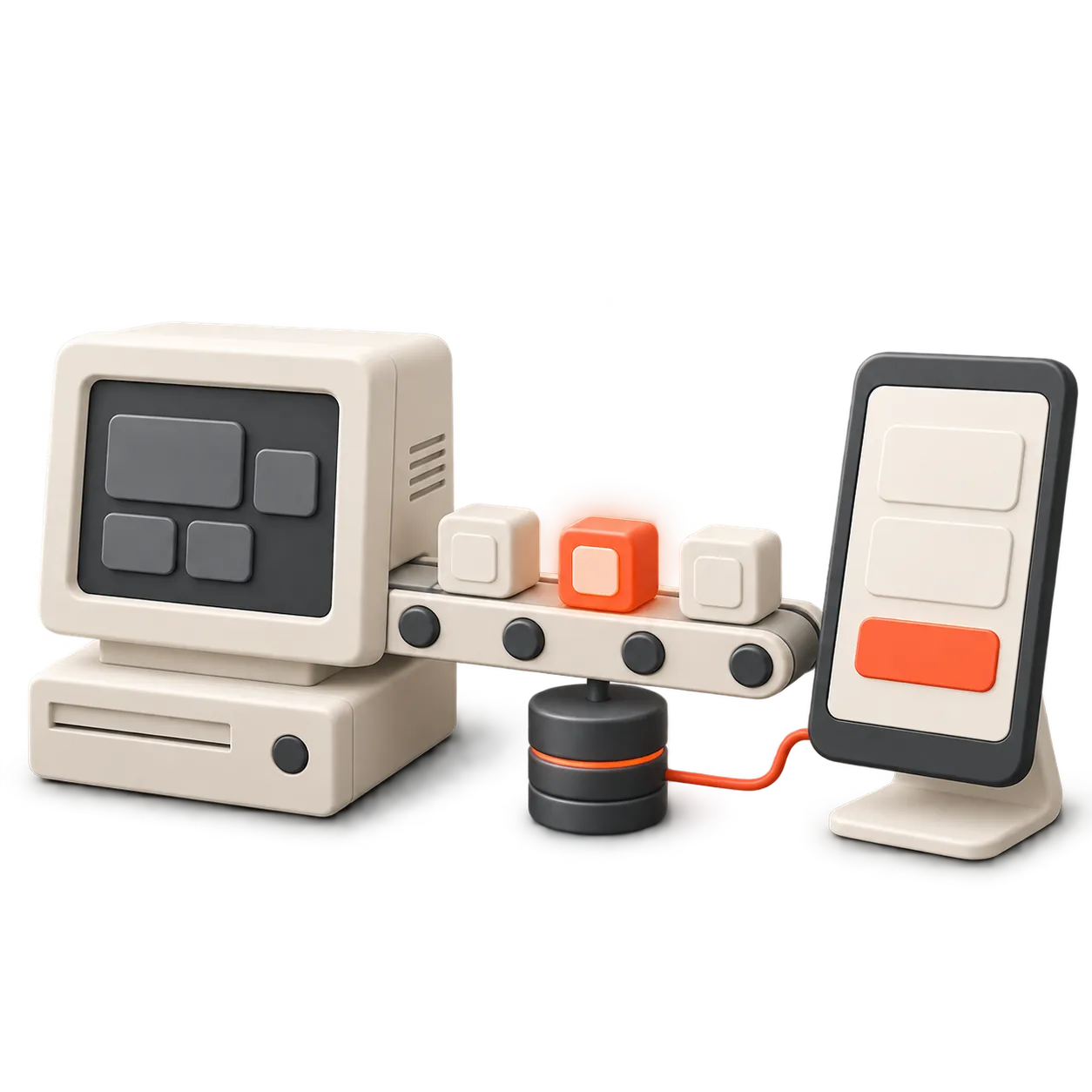
An old application holds years of business rules: discounts for specific customers, exceptions in pricing, reports someone checks every Monday. Many of them are not written down anywhere except in the code. Before recommending a rewrite, we read the code, the data and the integrations, and talk to the people who use and support the system.
The audit ends with a plan: which parts to rebuild, which to refactor, which to keep, what each step costs and what could go wrong. You can use the plan on its own or continue with us.
A complete rewrite stops improvements for months and puts everything at risk on the day of the switch. We replace the application one workflow at a time. The new part runs next to the old one, uses the same data and URLs, and takes over when it has proven itself with real users.
For North Suburban Limousine, we rebuilt the booking application with a Next.js frontend and a Symfony API, replacing the older Yii-based system. Customers enter their trip, choose a vehicle and see a price breakdown before saving a card; staff manage trips, payments, destinations, vehicle types and discount codes in one administration interface.
Data is where modernization projects fail quietly. We map the old structure to the new one, clean up duplicates with you and run the migration repeatedly on copies of production data. Counts, totals and spot checks show that customers, orders and history arrived intact. North Suburban Limousine’s data was migrated from the previous system before the new version launched.
Stores built on Magento or WooCommerce often become expensive to update and slow to extend. We move the catalog, customers, order history and content to a new platform or a custom storefront, keep product content and structured data, and redirect every old URL so rankings follow. See custom e-commerce and B2B ordering for what the new store can do for manufacturers and distributors.
Modernization is often the right moment to leave an aging server. We plan the hosting together with the application, so the new version is built for its environment rather than lifted into it. Chicago Boat Company’s reservation platform, first built in 2014, was rebuilt in 2024 to bring the Chicago Electric Boat Company and Chicago Cycleboats projects into one platform, and runs on AWS. See cloud consulting and development on AWS.
Each milestone ends with something running in production: a rebuilt workflow, migrated data or a retired server. You own the code and documentation, and the old system is switched off only when nothing depends on it anymore. For connecting the new application to the rest of your systems, see API development and system integration.
Companies whose booking, ordering or internal system still works but is slow, hard to change and understood by fewer people every year.
Businesses whose e-commerce platform is costly to maintain, blocks new features or is reaching the end of its support.
A review of the code, data, integrations and hosting, the risks of each option and a plan that ranks what to rebuild, refactor or keep.
New modules replace the old ones one workflow at a time, behind the same URLs and data, so users move over gradually.
Mapping, cleanup and repeated test migrations of customers, orders, bookings and history, with counts and spot checks before the switch.
A rehearsed cutover, redirects for every old URL, monitoring after launch and documentation of the new system.
A booking application rebuilt from an older Yii-based system into a Next.js frontend with a Symfony API. It handles airport transfers, round trips, multi-stop journeys and hourly bookings with pricing by distance, vehicle, stops, time and extras. We migrated the data from the previous system and launched the new version.
A reservation platform first built in 2014 and fully rebuilt in 2024, bringing Chicago Electric Boat Company and Chicago Cycleboats into one booking system, running on AWS.
A redesign of the public website and private trade portal for a truck parts network, with role-specific views for suppliers, distributors and administrators.
Read the code, talk to the people who use and support the system, and agree which workflow to move first and how success is measured.
Senior engineers use AI-assisted delivery to target the first working release in 14 days. It runs next to the old system on real data until the results match, then the next part follows.
Pricing: Fixed price per milestone, no hourly billing. About a third of a traditional team's quote for the same scope. The audit is a milestone of its own, so you know the full plan and its cost before committing to the rebuild.
Rarely all at once. A full rewrite freezes new features for months and risks losing rules nobody wrote down. We rebuild in parts, keeping the old system running until each new part has proven itself, and rewrite completely only when the old code cannot be extended safely.
They should notice a faster, clearer application. We keep URLs, logins and data where possible, rehearse the cutover on a copy of production data and schedule it for a quiet period. Anything that has to change is communicated in advance.
Yes. We move products, customers, order history and content to the new platform or a custom storefront, map every old URL to its new address and check search indexing after launch. The choice of target depends on your catalog, B2B needs and integrations.
We map every table that matters, clean up duplicates and dead records with you, and run the migration several times on copies before the real switch. Counts, totals and spot checks confirm that the data arrived.
Yes. The audit covers code quality, hosting, access and documentation. We fix the most urgent risks first, then agree whether to maintain, refactor or replace each part.
Choose the way you prefer to get in touch.
Pick a time for a 30-minute conversation. No need to fill out that form if you don’t want to :)
Book a 30-min callWrite to us directly at hello@devvela.com.
Your inquiry has been received. We will reply to the email address you provided.